Building the Perfect Home Theater: A Complete Guide for Atlanta Homeowners
A great home theater isn't just a big TV in a dark room. It's a purpose-built space — engineered for acoustics, calibrated for picture quality, programmed for simplicity. Done right, it's the room in your home that you never want to leave.
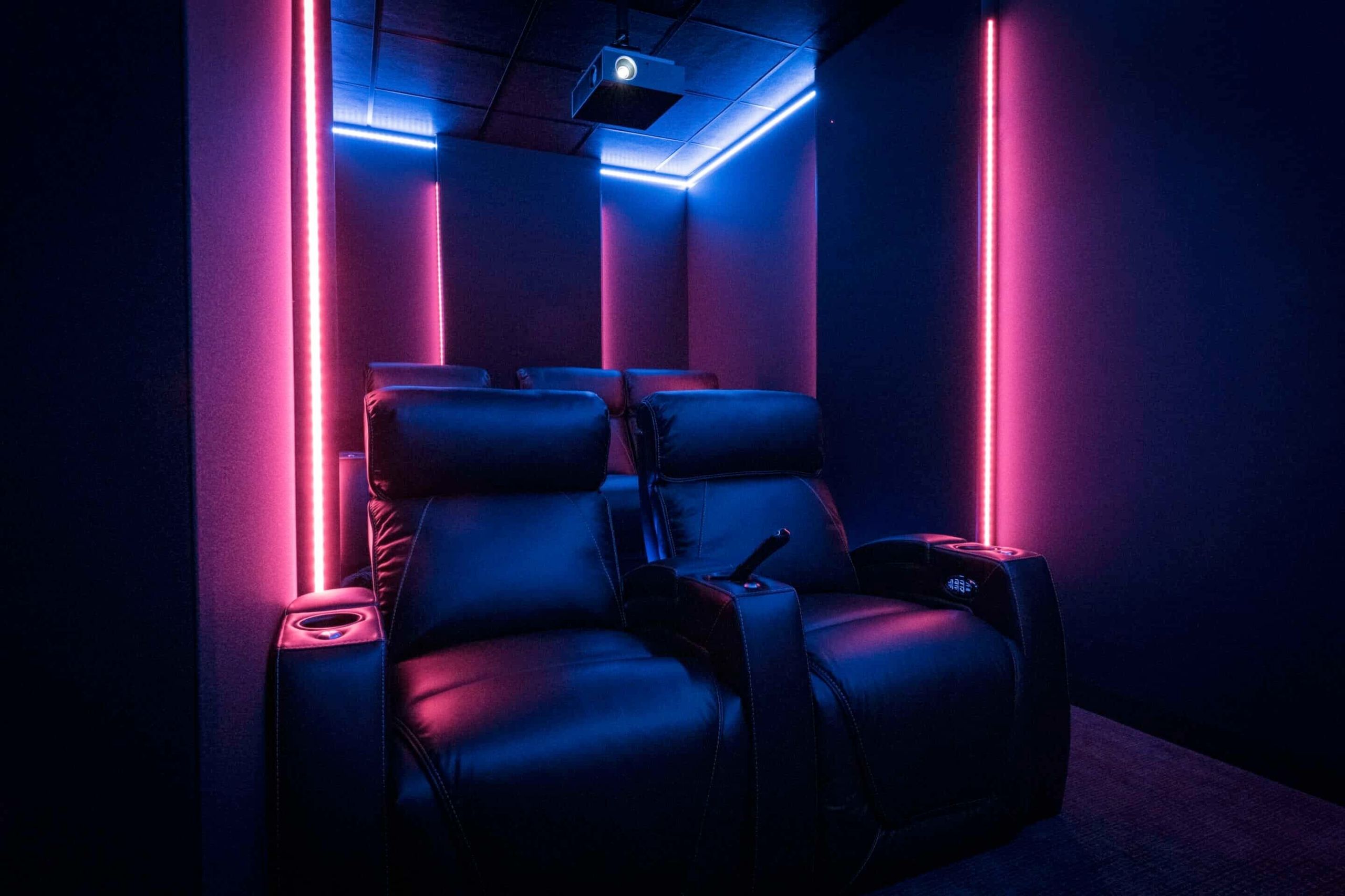
We've designed and installed dozens of home theaters across Atlanta, Buckhead, Sandy Springs, and Alpharetta. Every project teaches us something new. But certain fundamentals never change: the room has to be right, the equipment has to be matched, and the control system has to make it effortless. Get all three right and you have something genuinely extraordinary.
This guide covers everything you need to know — from choosing the right room to selecting your screen and audio, through to Crestron control integration that makes operating a $200,000 theater as simple as pressing one button.
DLSAV difference: We don't resell manufacturer packages. Every system we build is custom-designed for your specific room dimensions, seating layout, content preferences, and aesthetic. We calibrate every display and audio system to ISF and THX standards after installation.
Step 1 — Choosing the Right Room
The most important decision in home theater design isn't the projector. It's the room. Acoustics are determined before a single wire is pulled. A rectangular room with hard parallel surfaces will fight you acoustically no matter what you spend on speakers. A properly treated room makes a mid-tier system sound incredible.
Dimensions and Aspect Ratio
Ideal home theater rooms follow specific dimensional ratios to avoid standing waves — the acoustic resonances that cause boomy, uneven bass. A common starting point is a room with length-to-width-to-height ratios of roughly 1.6 : 1 : 1.25. If you're building new construction, this is worth discussing with your architect early. If you're working with an existing room, acoustic treatment can compensate significantly.
Dedicated vs. Multipurpose
A dedicated theater — one used only for cinema — gives you the most control over acoustics, light, and seating. If you want a room that doubles as a living space, that's completely achievable, but the design process is different. We design both. The key is being clear about how the space will be used before we begin specifying equipment.
Step 2 — Projection vs. Direct View Display
For a true cinematic experience, projection wins. A properly calibrated 4K laser projector on a 120–150" screen in a light-controlled room creates an image that simply cannot be matched by any flat panel display at any price. The sense of scale changes everything about the viewing experience.
4K Laser Projection
Laser projectors have replaced lamp-based models as the performance standard. They offer 20,000+ hour lamp life, instant on/off, consistent brightness, and exceptional color gamut. For a dedicated theater, we typically recommend laser projectors from Sony, JVC, or Epson at the top performance tiers — all capable of genuine 4K resolution with HDR support.
Acoustic Transparent Screens
Acoustic transparent (AT) screens are a game-changer for home theater. They allow your center and left/right speakers to be positioned behind the screen, exactly where the sound should come from relative to on-screen action. The perforated surface is invisible at normal viewing distances and eliminates the audio compromise of traditional side-mounted speakers.
High-Performance Flat Panels
For media rooms that also serve as living spaces, large-format OLED or MicroLED displays — 77" to 110" — deliver stunning picture quality in ambient light conditions where projection falls short. We integrate these displays into Crestron-controlled systems just as seamlessly as any projection setup.
Step 3 — Audio — The Soul of the Theater
In our experience, homeowners consistently underinvest in audio relative to video. The screen is what you see when you walk in — it's the impressive part of a reveal. But audio is what you feel. A room with good-to-great audio and excellent audio engineering is far more emotionally engaging than a stunning picture with average sound.
Immersive Audio Formats
Dolby Atmos and DTS:X are the current standards for immersive audio. They add overhead channels — sound that moves three-dimensionally around and above you. For a dedicated theater, we typically configure a 7.2.4 layout (seven surround channels, two subwoofers, four overhead/Atmos channels) as a minimum for a full immersive experience. The subwoofers matter enormously — properly placed and calibrated, they produce physical impact that you feel in your chest.
In-Wall and In-Ceiling Speakers
For a clean aesthetic without visible speaker cabinets, in-wall and in-ceiling speakers from our partners at Origin Acoustics deliver audiophile-grade performance in a completely invisible installation. These are not budget builder-grade products — they're engineered for precision placement and optimized for room acoustics.
Step 4 — Acoustic Treatment
Acoustic panels, bass traps, and diffusers are the difference between a room that sounds like a theater and one that sounds like a concrete box. We work with acoustic designers to spec treatment that controls early reflections, manages bass buildup in corners, and achieves RT60 (reverberation time) targets appropriate for cinema reproduction. Treatment can be integrated into the room design invisibly — behind perforated wood panels, inside upholstered wall sections, or woven into the room's architectural details.
Step 5 — Crestron Control Integration
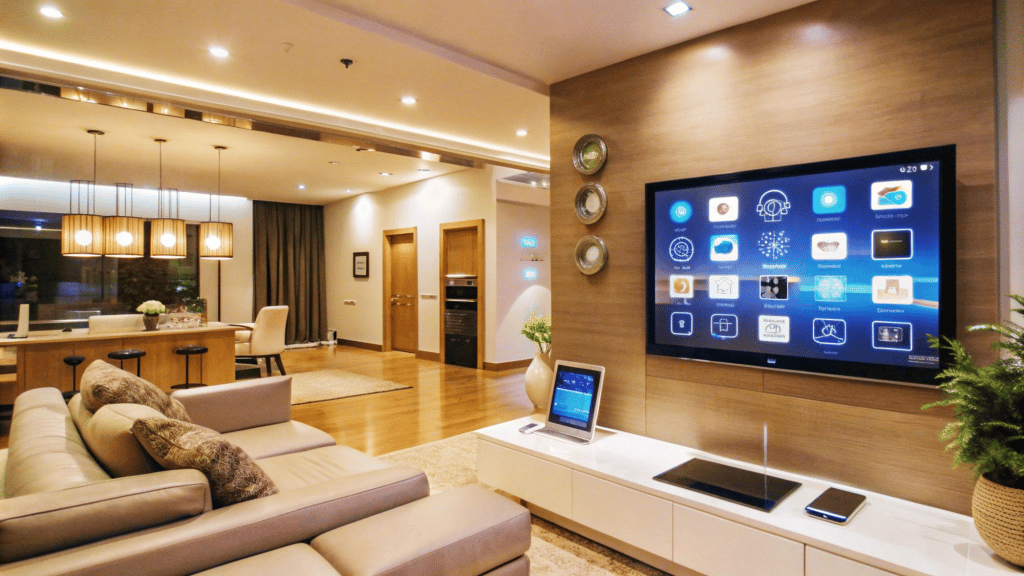
The most technically sophisticated home theater in the world is only as good as its usability. If your family members won't use a room because the remote is confusing or there are too many inputs to manage, the investment is wasted. This is where Crestron changes everything.
A single "Watch a Movie" button on a Crestron keypad or touchscreen closes the motorized blackout shades, dims the house lights to theater level, powers up the projector, drops the screen, switches to your preferred streaming input, and sets the audio to your calibrated home theater preset — in under 30 seconds, automatically. "Pause" brings lights up gently. "Goodnight" shuts everything down and arms the security system.
The one-button rule: We design every home theater so that a first-time guest can operate it without any instruction. If they need help, we haven't done our job.
What Does a Home Theater Cost in Atlanta?
Honest answer: it depends significantly on the room, the equipment tier, and the scope of construction work required. A well-executed media room with a high-performance 85" OLED, 7.1 surround sound, and Crestron control starts around $35,000–50,000 fully installed. A dedicated purpose-built theater with 4K laser projection, Atmos audio, acoustic treatment, and custom seating typically runs $80,000–150,000+. We've built systems at every point in this range and beyond.
The best way to understand what's right for your space and budget is a free consultation. We'll walk through your space, listen to how you want to use it, and put together a system design that maximizes your investment.